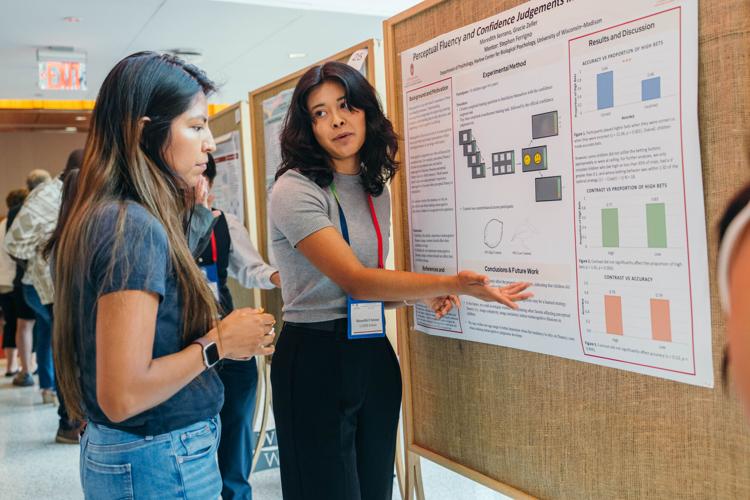
Photo by Paulius Musteikis
As a sophomore, Meredith Serrano has already built an impressive research resume. Through College of Letters & Science programs like Undergraduate Research Scholars (URS) and Letters & Science Summer of Excellence in Research (LASER), she has had the opportunity to work in multiple labs and professionally present her findings. URS opened the door for Serrano, who is double majoring in psychology and neurobiology. She started in a psychology lab researching the benefits of sensory, motor and cognitive environmental enrichment with Allyson Bennett, a professor of psychology. Then, as part of the LASER program, she moved on to study evolutionary cognitive processes through a lab with Stephen Ferrigno, an assistant professor of psychology. When the summer of research ended, she continued her work at the lab investigating perceptual fluency and confidence judgements in early childhood and the development of the approximate number system. She has also joined the McNair Scholars Program where she is gaining more research experience in preparation for graduate school.
What’s your current research about?
In the Cognitive Origins Lab, we study the evolutionary origins of human cognition by comparing human abilities with those of children, adults from different cultures and non-human animals. A lot of my current focus is on the development of the approximate number system, with the hope of finding ways and interventions to potentially help children in mathematics and learning of that nature.
What have been some of the milestones in your research journey?
When I joined the lab, I knew nothing about cognitive psychology. I had been looking more at psychopathology, and I still find that very interesting. Exposure to this field and learning more about it, in addition to the metacognition project, was a milestone. We were able to make a poster by the end of the LASER program, where we all presented at the symposium. And I really got to dive deep into the project and get a full understanding of our data, which was very exciting. I was able to learn more about something that I initially knew nothing about. I definitely wouldn’t have reached these milestones if it weren’t for these research programs, my mentors and my lab manager Gracie Zeller.
It’s confirmed my passion for supporting others’ wellbeing, which is why I want to pursue a PhD in clinical psychology. Working as a research assistant and peer wellness coach has shown me the value of interpersonal work, and I hope to continue as a clinical psychologist in the future. Time at the Cognitive Origins Lab has also solidified my interest in working with kids.