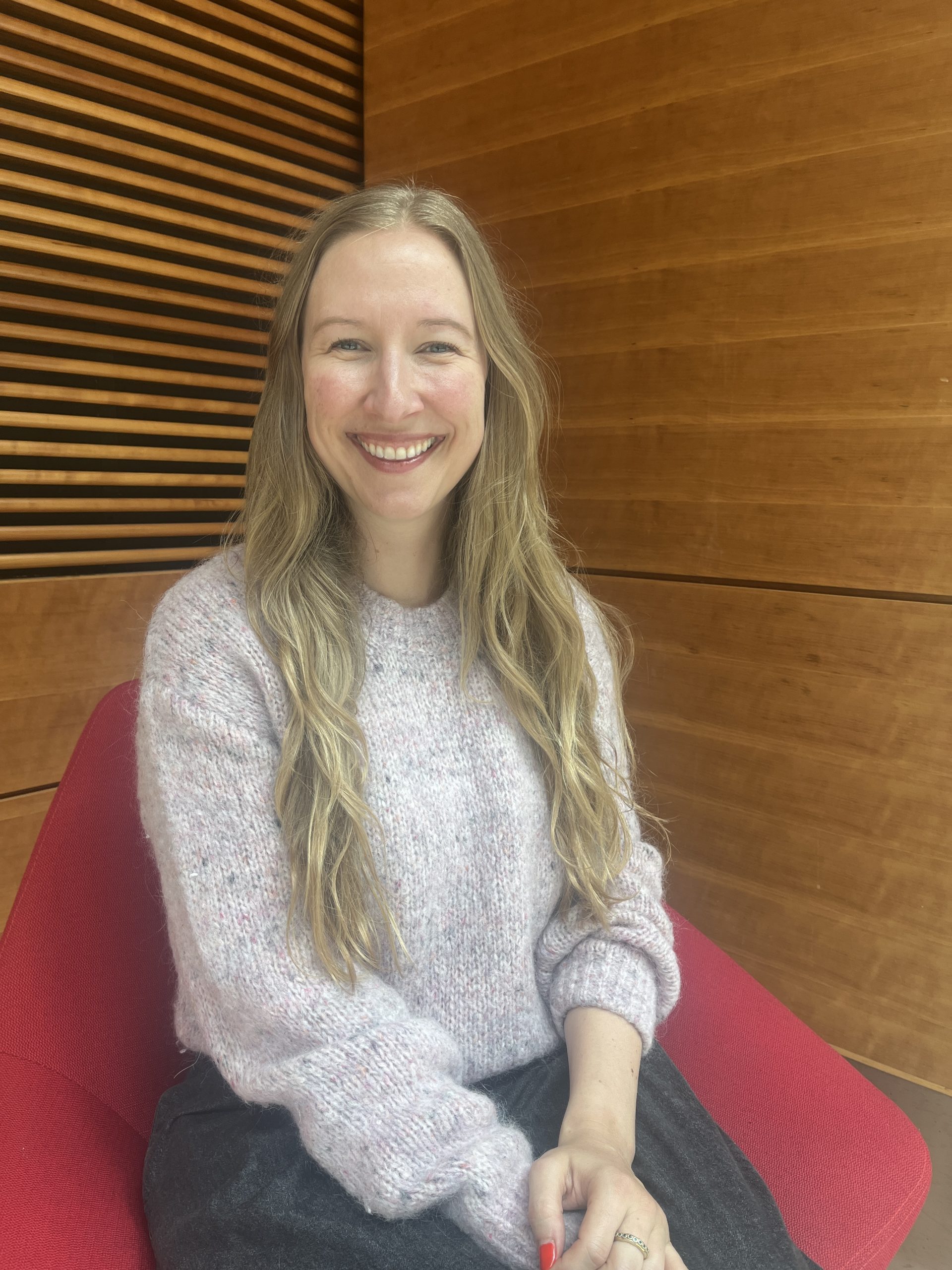
The Department of Psychology is delighted to introduce new faculty member Tatum Jolink who joined us this fall after completing a three-year postdoctoral research fellowship at the University of Michigan. Jolink earned her undergraduate degree in Plan II Liberal Arts Honors, Psychology, and History from the University of Texas at Austin and a PhD in social psychology with a concentration in quantitative psychology at the University of North Carolina at Chapel Hill. She, her partner, and their dog Birdie also welcomed a son, Hawes, this summer.
Hometown: I am a fifth-generation Texan. My parents met at Texas (UT-Austin), and I was born and raised in Austin.
How did you get into your field of research?I study close relationships, specifically how we get into and hold on to our relationships. I examine affiliative behaviors, such as affectionate touch, shared laughter, sex, and gratitude, that help strengthen new and existing relationships. I also integrate biological systems (e.g., immune system, sympathetic nervous system, sleep) into my research on relationships, looking at both the health consequences of relationship experiences as well as how those biological systems contribute to and shape interactions with close others. Finally, I’m really interested in modern dating: How are connections initiated online? Which online matches translate to offline relationships? Can we predict compatibility before people first meet? What makes initial interactions go well?
My research in this area began in college. It all started with a senior honors thesis, which turned me on to relationship science. During and since, I have worked with some great mentors and lab mates, who have inspired and pushed me. But really, I’m intrigued by this question, which I will keep puzzling over my whole career: How can two people in a relationship, with their individual backgrounds, personalities, behaviors, motivations, etc., operate differently together than they would otherwise alone? What makes the relationship unit special? And is any of that specialness predictable?
What attracted you to UW–Madison?My conversations with the people, the immediate feelings of connection, the sense that I could be myself, even whilst interviewing, all helped this place feel like it could be home. I trusted that gut instinct when deciding to take this job and today I know for certain it was the right choice. I’ve only met more people—graduate students, university staff, undergraduates, other faculty—who affirm how singular and wonderful UW is. We’re happy to be making our home here.
What’s the most important lesson you wish to convey to students?The easy answer is the Terrace, which has been showing off this summer! But I’ve enjoyed exploring the lakeshore trail, like taking a jog out to picnic point. I love seeing the land’s history sprinkled along the trail and passing everyone from students having a class to locals driving up on their boat. It’s great that many campus spots are accessible to everyone. And indoors, it’s cheesy, but my office in the Brogden Psychology Building. It’s where I get to work at my dream job!
Do you feel your work relates to the Wisconsin Idea? As a relationship scientist interested in understanding how people find and strengthen high-quality close relationships, I strive to share this knowledge in the classroom (as well as in the context of my research, such as with my lab and with our participants). We all have close relationships of some kind, whether with family, friends, or romantic partners. I feel a duty to share what I know with the community at UW-Madison so that they can then take that knowledge and apply it to their relationships.
What’s something interesting about your area of expertise that will make us sound smarter at parties?Some of my work is on relationship initiation—what makes initial interactions with potential friends or romantic partners go well? We have consistently (and robustly) found that shared laughter promotes relationships developing over time. That is, if you meet someone new, and y’all laugh together a lot during that first meeting, you are more likely not only to see that person again but also develop a relationship with them. It’s something to be on the lookout for in classes, at parties, at your new job. But it must be genuine; you can’t fake it! Shared laughter reveals a shared worldview, highlighting similarities that can help foster closeness with that new person.
Any hobbies or interests outside of your work? Oh, yes! Well, I just became a mom so hanging with my kid is now a hobby. He’s fun and he’s doing something new every day. I also love television and film, especially going to the movie theater with my partner. We don’t always like the same movies, but we always have lots to talk about.
I’m a big reader and into fitness and exercise. I commute on the Southwest Commuter Path and it’s the best, most wholesome vibe, communing with nature and checking in with myself as I go to and from work.
I also think one of my hobbies has to be talking on the phone! Most of my family and friends live elsewhere and I spend a lot of time fostering and maintaining those relationships over the phone! I love a good voice note, especially when it’s one of my friends or sisters making me laugh out loud in public when I’m by myself!