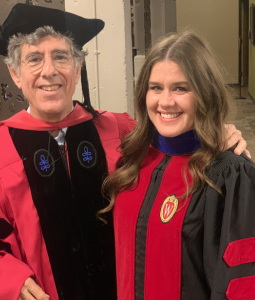
Alumni Profile: Sasha Sommerfeldt, PhD’23
Degree(s): BS in Psychology and Philosophy, University of Minnesota; PhD in Psychology, UW-Madison
Current Occupation: Senior Scientist, Humin, formerly Healthy Minds Innovations
What are some of the benefits of your psychology degree?
Psychology trained me to see behavior in nuanced ways, and that lens transfers everywhere. It impacts how I see people, supporting more understanding and empathy by parsing behavior along spectrums of really discrete dimensions, rather than broad generalities, and understanding they aren’t static but malleable for growth. In industry, I work with messy real-world data where human behavior is almost always in the mix, and my training gave me the statistical and measurement design toolkit along with the conceptual complexity to handle it.
How did you find your way to your current profession?
I came to Psychology from a really deep interest in how subjective experience arises from the physical lump of meat that is our brains and bodies. Psych labs doing neuroimaging and physiological measurement were a natural fit, and once I was in, I just kept finding more to love: data, code, writing, and the creativity of coming up with new experimental designs or measurements that have never been done before for some amorphous concept. That thread led me to my current role as a Senior Scientist at a wellbeing science nonprofit, where I apply my blend of data science, psychometrics, and behavioral research to measuring products or services; a combination that feels like a direct extension of everything I was trained to do.
What advice would you give to students graduating with a psychology degree?
Psychology is a launchpad for data, UX, policy, and healthcare roles. One of the steepest learning curves coming out of academia was using all those research skills towards fast, real world impact; there’s a fundamental shift in prioritizing what’s useful for informing a decision right now. Embracing that type of continuous learning and adaptation feels essential. Universities provide so many resources, use them! UW’s SuccessWorks offers career advising after you graduate, peers you met in the program can be lifelong resources for bouncing ideas off of. Wherever you land, find interesting talks, panels, or workshops open to the community at a local university!
What was the biggest takeaway from your time in the Department of Psychology?
The idea of an inverted-U relationship — the idea that too little or too much of something (stress, arousal, dopamine) produces worse outcomes than a middle “goldilocks zone” — from a psychopharmacology lecture has been a repeat soundbite I bring into a surprising number of situations. In industry, important relationships are often nonlinear: pricing, engagement, product complexity. People often default to modeling linear relationships, assuming more is always better, but when you probe them it rarely matches how they actually think about the phenomena. A simple quadratic is often an easy fix. The broader takeaway: that fluidity between nuanced thinking about real-world phenomena and knowing how to model them statistically. (Thanks, Craig Berridge and Markus Brauer!)
What is a favorite memory or learning from your time in the Department of Psychology?
First year PhD students in the department all take a year long stats course. I was lucky to have [former grad student] Mitchell Campbell as one of my TAs; he built real community through it, including hosting a brunch potluck for one of our final sessions. That course was where stats genuinely clicked for me: everything building on the linear model, developing deep understanding rather than memorizing discrete tests. It’s also where I got to know my cohort, who became lifelong friends and some of my favorite humans.
If interested, please list an identity or group membership of which you are particularly proud:
First-generation Bachelor’s student
Connect on LinkedIn